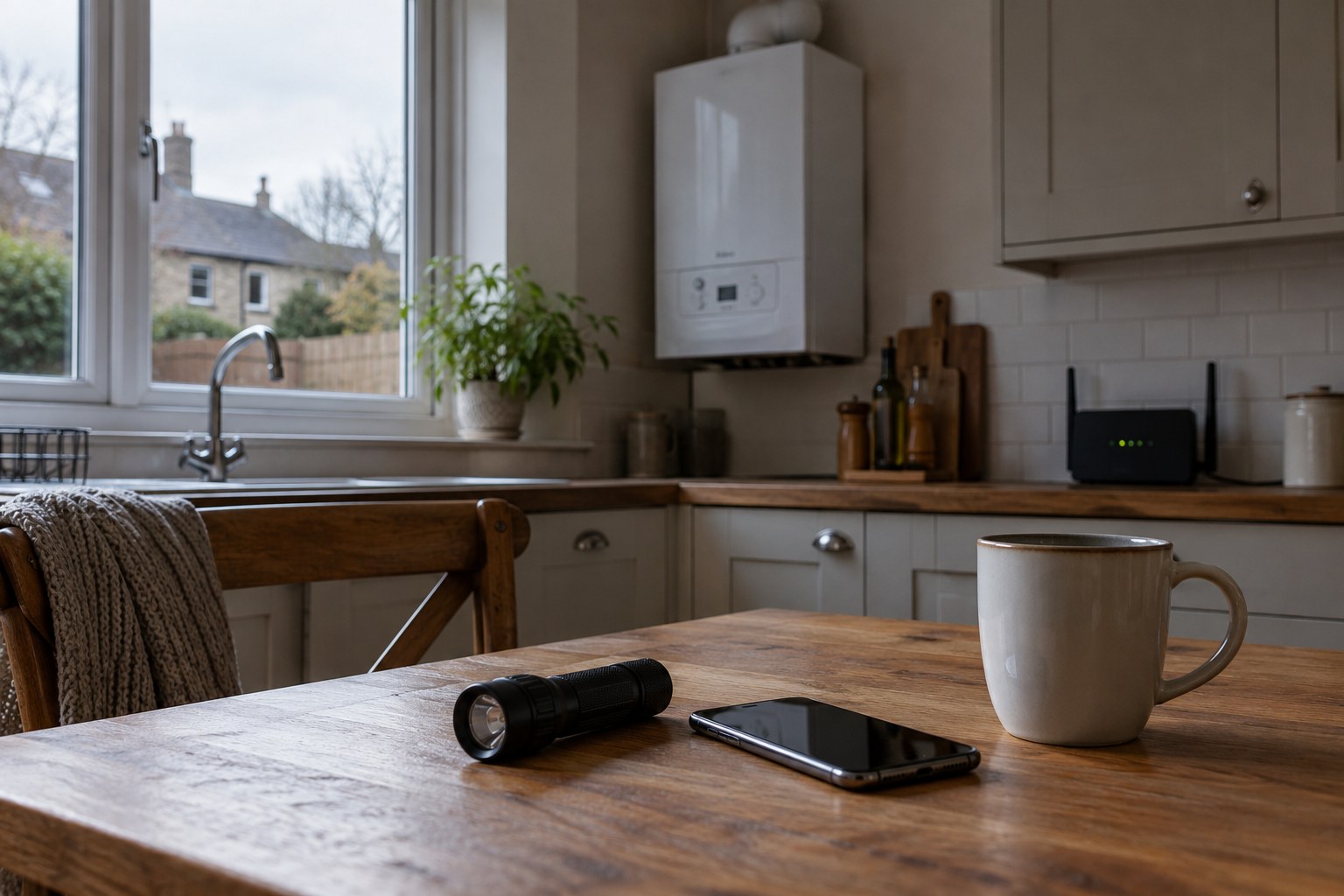
A typical modern gas central-heating system still needs electricity. Its controls and pump cannot normally run on the gas supply alone. That makes heating a useful place to start when checking which everyday services depend on mains power. [1]
The practical task is to find the assumptions in your own home. A label such as “gas heating” tells you the fuel; it does not describe the complete system.
Follow the routine, then find the equipment
Choose an ordinary evening. You come home, turn up the heating, cook, call someone and charge your phone. Write those routines down before listing equipment. This keeps the exercise focused on what you need to do.
For each routine, ask three questions: what makes it work, what would be available without electricity, and what have we actually checked? The final question matters. A possible solution in a shopping basket is different from an arrangement everyone at home understands.
| Routine | Dependency to confirm | Decision to record |
|---|---|---|
| Keeping warm | Boiler, pump and controls | Where are existing warm layers and bedding? |
| Making contact | Router, handset and network | Which contact method have we checked with the provider? |
| Preparing a meal | Cooking and refrigeration | What suitable food can we eat without either? |
| Finding information | Phone, cloud account and connection | Which instructions should be available on paper? |
Separate a backup from an assumption
Digital landlines require mains electricity unless a suitable backup is available. Ofcom advises people who rely on a landline and lack a working mobile or reliable signal to speak to their provider. [2] A phone battery and a working communications network are separate parts of the chain.
Record the provider’s answer alongside the device or service name. If you cannot confirm the arrangement, mark it “unknown” and give that question an owner. This is more useful than a reassuring tick without evidence.
Do the same for heating equipment. Use its manual or ask the installer. Any proposal to power fixed heating equipment from another source needs competent professional advice.
Make one useful decision today
Start with the routine that would be hardest for your household to lose. Write a plain sentence: “If this stops, we will do this, using these items, stored here.”
For warmth, that might mean knowing where existing bedding and suitable clothing are kept. For meals, it might mean agreeing one familiar option that needs no cooking. For information, it might mean putting the provider’s contact details beside the household notes.
These are planning choices. They give you a specific gap to resolve before you decide whether buying anything is necessary.
Keep a short dependency record
Use four headings: service / what it needs / agreed fallback / still to confirm. Keep the record where other household members can find it. Avoid storing the only copy inside the system it describes.
Revisit an entry when the equipment changes. A new router, heating controller or phone service can make an old assumption unreliable even when the daily routine looks identical.
The free Power Dependency Check helps you organise the first pass. Its matching planning system is READY/02 — Power / 72 Hours, for retaining the decisions you want to keep offline. The useful first step is still the check: discover the actual gap before choosing a product.
CHECK YOUR HOME’S POWER DEPENDENCIESSources
Source review: 2 November 2026. READY/ Editorial. Independent planning aid; current official and provider instructions take priority.