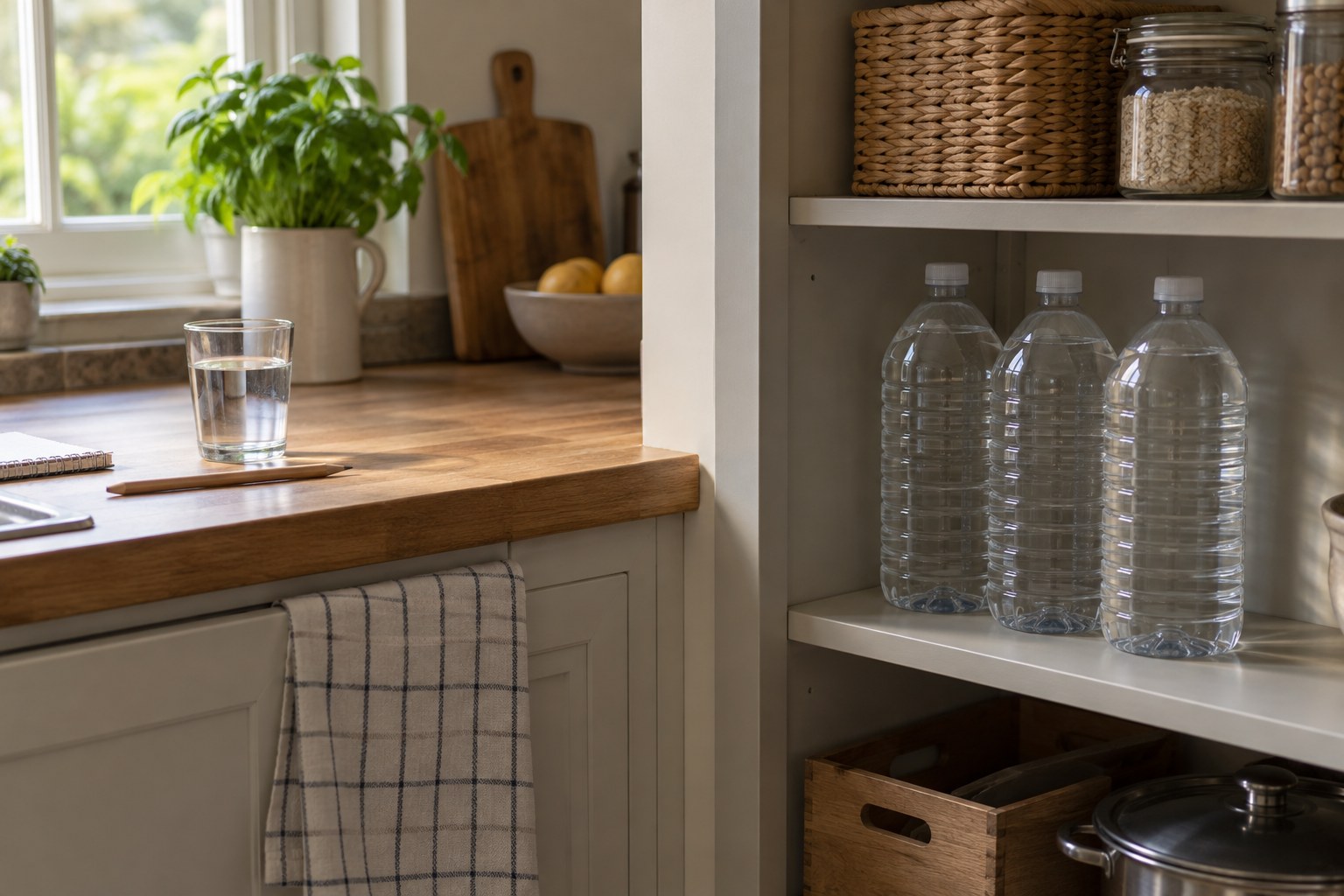
Current UK Be Ready guidance recommends 3 litres of drinking water per person per day for three days. That is 9 litres per person, or 27 litres for three people. Other uses, including cooking and washing, need additional provision. [1]
The number is a starting point. A workable plan also says what is already available, where it will go and which household needs are still unresolved.
Calculate the baseline separately
Use people × 3 litres × 3 days for the drinking-water baseline. Keeping it separate from other uses makes the result easier to understand. Do not describe it as a complete allowance for everything the household does with water.
| People | Three-day drinking-water baseline |
|---|---|
| 1 | 9 litres |
| 2 | 18 litres |
| 3 | 27 litres |
| 4 | 36 litres |
Babies, pets and medical needs can require additional planning. Be Ready advises speaking to the care team where a medical device depends on water. [1] Avoid treating a general-purpose calculator as an individual care plan.
Count what is already there
Check your existing sealed drinking-water bottles before making a shopping list. Read the dates and storage instructions. Record the usable amount against the drinking-water target.
A useful note has three values: baseline / already available / remaining gap. For example, a two-person household starting with 6 litres would have 12 litres left to reach its 18-litre drinking-water baseline. That calculation says nothing about the separate allowance needed for other tasks.
This gives a specific next decision. It also avoids repeatedly buying a little more without knowing whether the original target has been reached.
Choose storage you can actually use
Look for a location that suits the bottle instructions, remains accessible and does not create a handling problem. Consider how each person would retrieve what they need. A container that someone cannot comfortably manage may be inconvenient when it matters.
Keep the arrangement simple enough to check. If supplies are spread between several places, put all the locations on the same inventory. A total hidden across forgotten cupboards is hard to maintain.
If you cannot reach the target immediately, record the gap honestly and build up what you can. The purpose of the inventory is to support the next decision, not to award a preparedness grade.
Keep drinking and non-drinking supplies distinct
Be Ready warns against drinking rain-butt water. [1] Do not count a garden water butt as part of the bottled drinking-water baseline.
This article does not provide instructions for treating an unknown water source. During an interruption, follow your water company’s current advice about supply, collection points and any restrictions.
Make maintenance part of the arrangement
When you use or replace a bottle, update the inventory. A small note beside the storage location can be easier to keep current than a complicated tracking system. Check the plan again if the number of people or household needs changes.
Use the free Water / 72H Calculator for the baseline, then record the storage decision and remaining questions. READY/03 — Water / 72 Hours is the matching planning system for keeping those decisions together.
CALCULATE YOUR THREE-DAY DRINKING-WATER BASELINESources
Source review: 2 November 2026. READY/ Editorial. Independent planning aid; current official and provider instructions take priority.