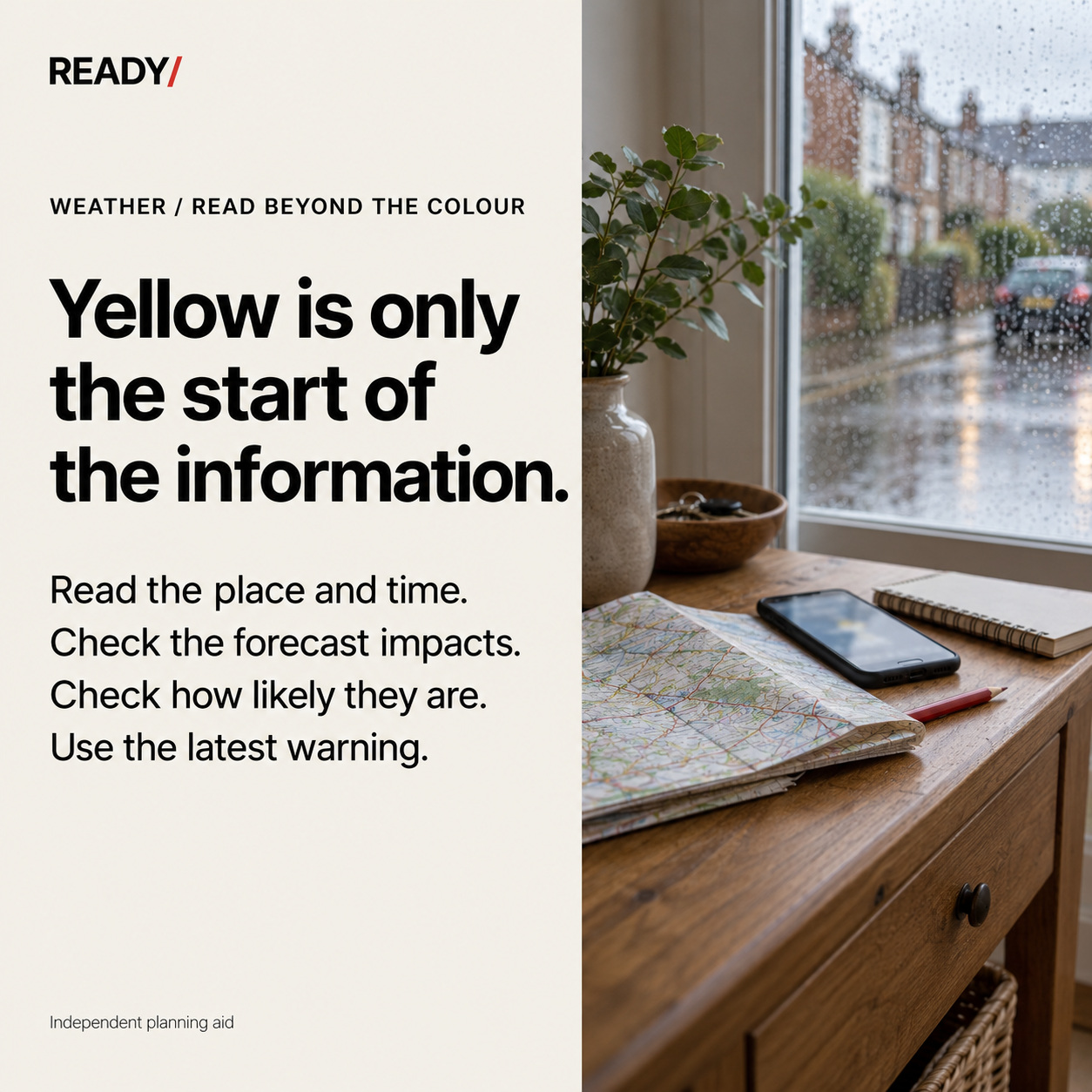
A colour is quick to recognise. It is less useful on its own when you have to decide whether to travel, change a delivery or contact the organiser of an outdoor event. The planning task is to connect the warning’s detail to an actual commitment.
Read what the colour is summarising
The Met Office combines impact and likelihood when setting a warning colour. A yellow warning can describe different combinations, including lower likelihood of more significant impacts. Its guide explains the warning’s area, timing, expected effects and supporting detail. [1]
That is the factual starting point. The decision sheet below is a READY/ planning suggestion, not a Met Office instruction or a rule that any particular activity should proceed.
Give the warning a job
Start with one decision you genuinely need to make. “Be prepared for weather” is too broad to hand over. “Check whether tomorrow’s delivery arrangements need changing” gives someone a task and a deadline.
Use a short record:
| Field | What to write |
|---|---|
| Activity and location | The actual journey, visit, delivery or event |
| Official information checked | Warning source and the time you read it |
| Relevant detail | The stated area, time window and impact affecting this activity |
| Other decision-maker | The operator, organiser or service that controls part of the plan |
| Our next action | One task, with a named person |
| Review time | When to check for an update before committing |
Keep the source wording available alongside your notes. A household summary should make the detail easier to use, rather than replace it with a new unofficial forecast.
A worked planning example
Illustrative exercise only: this is not a current warning or forecast.
Imagine you are helping organise an outdoor community event. One volunteer shares a warning screenshot. Another says the colour looks familiar, so the event should be fine. Neither message settles the event’s arrangements.
A more useful note would say: “Alex will read the current official warning for the venue and event hours, ask the organiser what decision process applies, and report back before equipment is loaded. The organiser’s update will be kept with the event notes.”
This example does not invent a wind threshold or tell the organiser when to cancel. It identifies the missing information and assigns responsibility. That is a decision you can prepare without pretending to be a forecaster.
Leave room for an update
An early plan can become stale. Put the checked time next to the conclusion and name the point when you will review it. If the plan changes, replace the old message clearly rather than adding another unexplained screenshot to a long conversation.
For a household, one person might keep the current note and tell everyone what has changed. For a small business, the person contacting customers may need the same decision that the person handling bookings is using. Agreeing that handover in advance reduces conflicting messages.
Make completion visible
You have finished this small task when someone can answer: what activity are we deciding about, which current information matters, who owns the next action, and when will it be reviewed?
Keep the record short enough to use. A warning colour can get your attention; a clear action and review time turn that attention into something practical.
Explore READY/ weather planning →