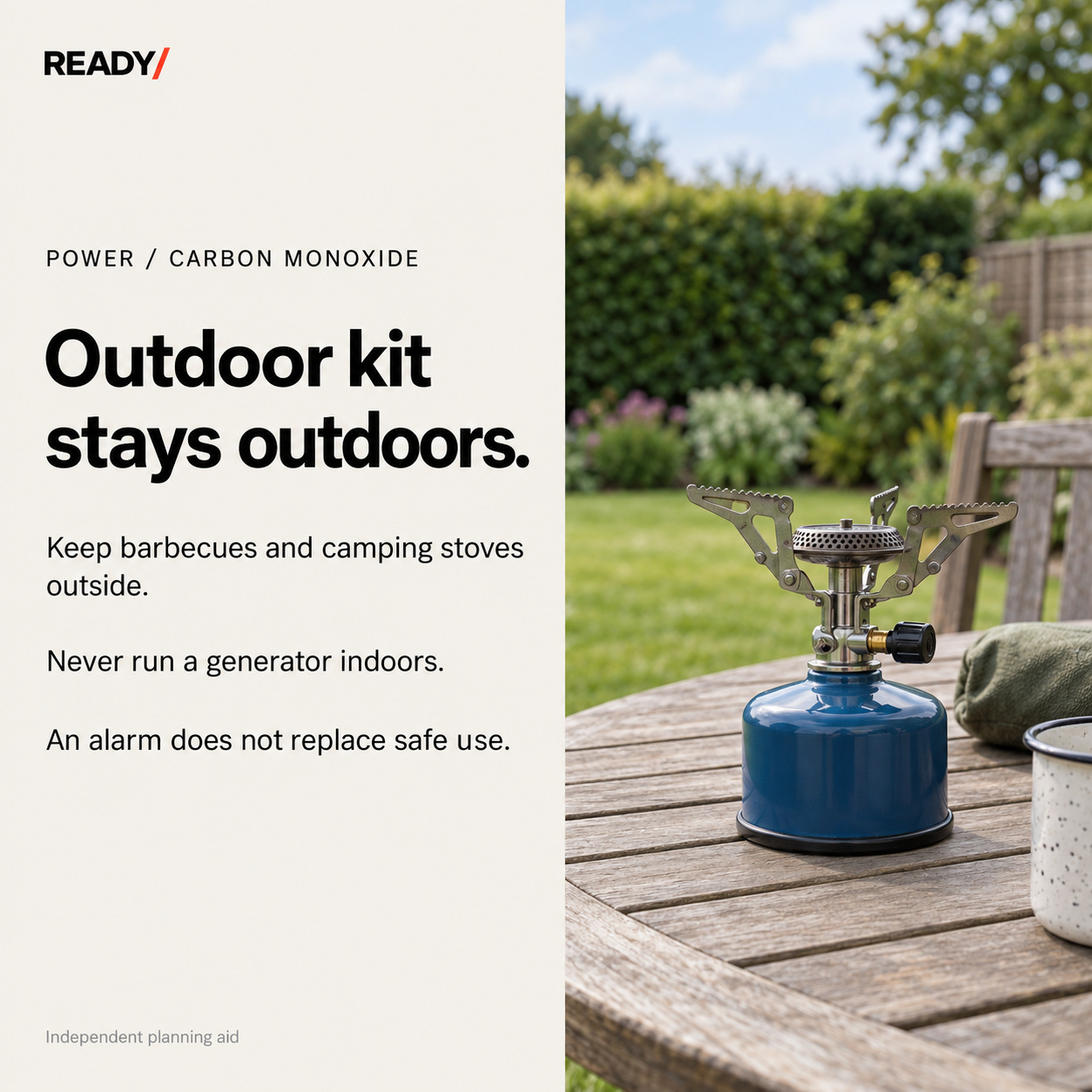
A household can own a camping stove and still lack a safe cooking fallback. It can own a generator without having a suitable place to operate it. The planning mistake is to record the object as if that settles the arrangement.
Start with how the equipment is allowed to be used, then decide whether it belongs in your household plan. Do that before an outage creates pressure to improvise.
Three assumptions to remove
“We would notice a problem.” Carbon monoxide has no smell or colour. The NHS warns that using barbecues or camping stoves indoors or in tents can cause a dangerous build-up. Do not treat a familiar fuel or an apparently normal flame as a safety check. [1]
“The garage door will be open.” HSENI says portable generators must not be used indoors or in partly enclosed spaces, including garages, even where there is partial ventilation. They should not operate near open doors or windows; fans do not prevent carbon-monoxide build-up inside the home. [2]
“The alarm makes it acceptable.” HSE describes CO alarms as a useful precaution, not a replacement for appliance maintenance and safety checks. Install and maintain an alarm according to its manufacturer’s instructions. [3]
These are different failures. The first substitutes your senses for information, the second substitutes an improvised location for a suitable one, and the third asks a warning device to justify the original risk.
Use a fallback decision card
For each item you are considering, answer this short set of questions:
| Question | A useful answer |
|---|---|
| What is the actual item? | Its model and the location of its instructions |
| What use is permitted? | The manufacturer’s conditions, read directly |
| What remains unconfirmed? | The arrangement or advice you still need |
| Does the plan depend on it? | Which household task currently assumes it is usable |
| What if it is unavailable? | An alternative that does not require the unsafe use |
This card is a planning filter, not an equipment inspection. Leave the item out of the usable fallback until the relevant questions are resolved. Do not test an unsafe arrangement to see whether the alarm reacts.
A useful example of saying no
Imagine a household note says, “Cooking: use the camping stove.” The household then realises it has no arrangement that meets the equipment’s safe-use instructions. Rewriting the note as “stove available, use not confirmed” is honest, but the cooking plan is still incomplete.
The next decision is to choose another workable arrangement, rather than quietly carrying the original assumption forward. A familiar meal that needs no cooking may resolve that particular task without turning the kitchen into an improvised campsite. The exercise is about the decision, not purchasing more kit.
Keep emergency advice separate
If you think you may have carbon-monoxide poisoning, go outside and get medical advice promptly; do not re-enter until advised. The NHS explains when to call 111 and when serious symptoms require 999 or emergency care. [1] Use that advice during a suspected exposure, rather than working through this advance-planning card.
A completed fallback is an arrangement you can explain and use safely. A product sitting in a cupboard is only a possible ingredient.
Run the free Power Dependency Check →