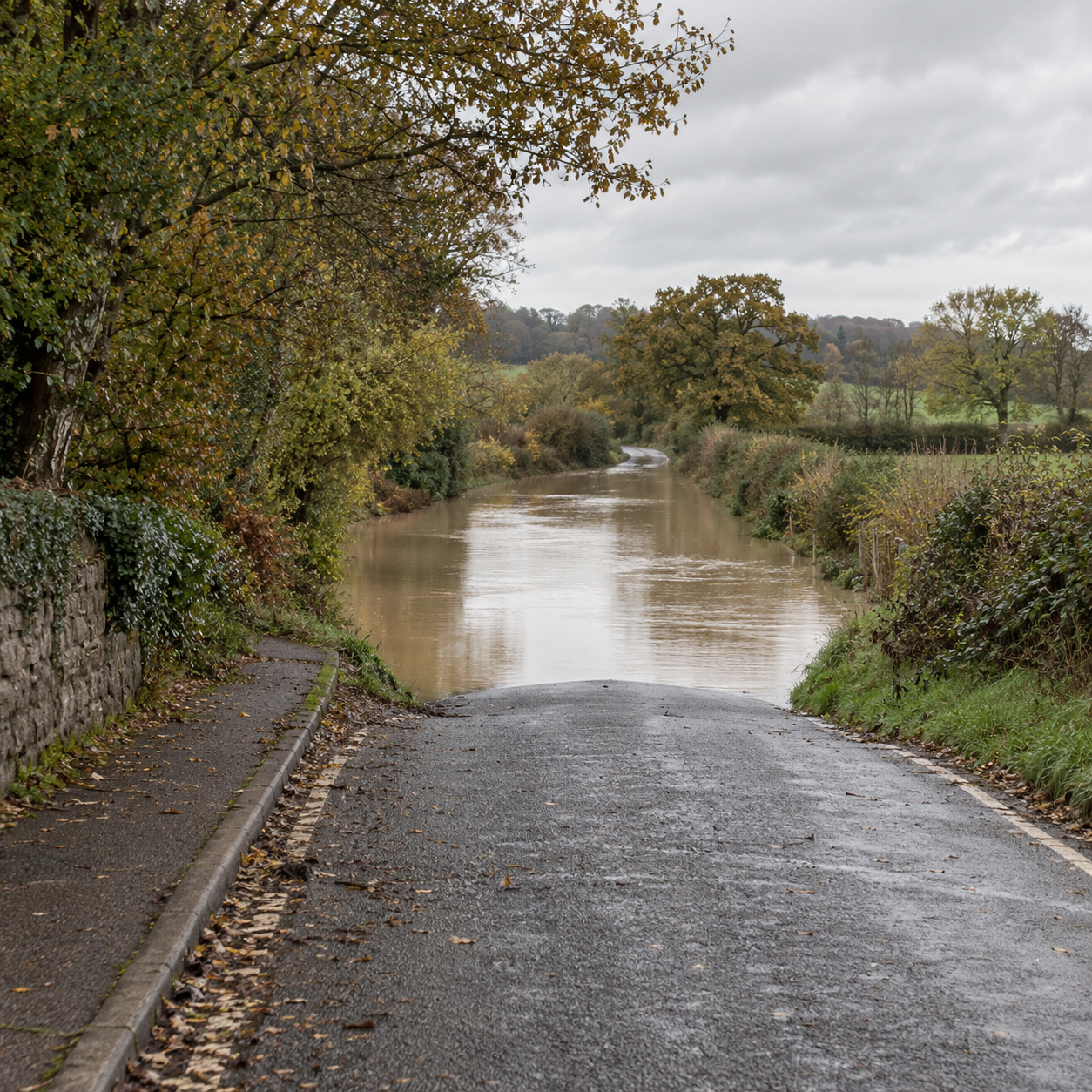
A flooded road turns a journey problem into a household coordination problem. Someone may be waiting for a lift, a delivery or an appointment. Without an agreed alternative, the driver can feel pressure to continue.
Plan what happens when arrival is no longer possible. Do not build the plan around deciding whether water looks shallow enough.
Keep the travel instruction clear
The Met Office advises against driving through floodwater: turn around and find another route. [1] Government guidance also says not to walk, cycle or drive through it. Water can hide damaged surfaces and other hazards. Its flood page links to the relevant advice for Scotland, Wales and Northern Ireland. [2]
The household task is therefore to organise alternatives around that instruction. A larger vehicle, a familiar road or another driver going first does not establish a safe route.
Agree the decision before departure
For a journey that matters to someone else, make a short advance note:
Purpose: What actually needs to happen, and by when?
Information: Which official traffic, flood or transport updates will we check?
Contact: Who needs an update if the journey cannot be completed?
Alternative: Can the appointment move, can an authorised person help, or can the task wait?
Authority: Who can decide to delay or cancel without needing to negotiate under pressure?
These are suggested coordination prompts. They do not establish that travel is appropriate or that a particular road is safe.
Separate another route from a safe route
A navigation app may propose a diversion. Treat that as a route to check, rather than clearance to use it. Conditions can also affect the road you usually think of as the backup.
For an advance exercise, imagine the usual road and the first alternative are unavailable. Which part of the plan still works? Perhaps the appointment can be rearranged, or a person already on the other side can complete a task they are authorised to do.
Write the arrangement in terms of responsibilities rather than promising that a named road will stay open. Do not create an automatic collection arrangement that the people involved have never agreed to.
Give a useful update
A practical message might be:
I cannot safely complete the journey. Please use our agreed alternative arrangement. I will update you when I have checked the next official information.
Adapt that to the circumstances. Send messages only once safely stopped; the point is to reduce pressure on the driver, not add another task while driving.
Keep current advice in charge
An old household note cannot override a closure, an evacuation instruction or emergency-service advice. If someone is in immediate danger, call 999. [2]
The value of this exercise is that people know a missed arrival can be managed. A postponed journey is an outcome the household has already considered, rather than a failure the driver feels obliged to prevent.
Write down the household handover before a journey is delayed →