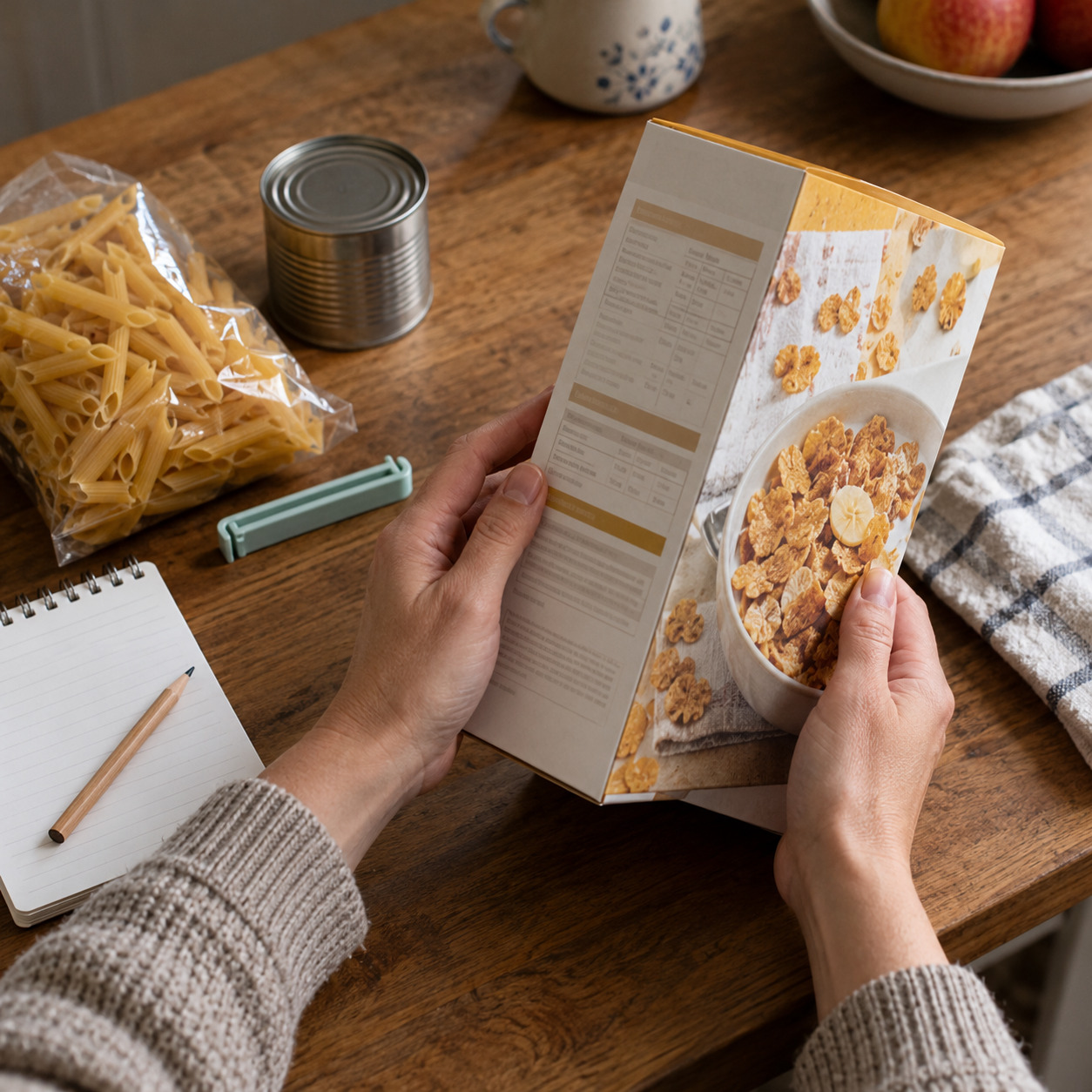
A food inventory becomes more useful when it keeps the meaning of the label. “Expires Friday” is a poor substitute for the actual date wording, storage conditions and instructions after opening.
You can improve the record without buying anything. Choose one familiar item, read its whole label and ask whether someone else could use your note correctly.
Keep the date type
Government food-labelling guidance distinguishes use-by dates, which concern safety, from best before dates, which concern quality. It also explains that food stored incorrectly can become unsafe before its use-by date. Read the storage and after-opening instructions as well as the date. [1]
Do not use smell to decide whether food carrying a use-by date is safe. The FSA’s fact checker explains that milk and some other dairy products can carry either date type: the actual pack is what matters. [2]
These distinctions are useful when one person buys food and another maintains the household list. A column headed “expiry” encourages them to flatten several instructions into one number.
Use a better inventory entry
The following is a suggested format, rather than a new food-safety rule:
| Field | What to copy or record |
|---|---|
| Item | Enough detail to identify the actual pack |
| Date wording | Use-by or best before, plus the printed date |
| Storage | The label’s conditions |
| Once opened | The label’s instruction, kept separate |
| Opened | Date, if needed to apply that instruction |
| Next action | Use in a planned meal, check a question, or replace |
Keep the packaging available while the food is in use. A notebook entry should help someone find the instruction, not become a competing version of it. If you cannot read or understand a label, resolve that question rather than filling the gap from memory.
Check one handover
Imagine the household list says there are two packs of the same product. One is unopened; the other was opened earlier in the week. An unchanged total of “two” tells the person planning a meal very little about which pack to look at first.
Add an opened/unopened distinction and the relevant instruction. You have improved the decision without adding a larger reserve, another container or a complicated spreadsheet.
Ask another household member to explain the entry back to you. If they interpret “best before” as a use-by instruction, or miss the after-opening condition, change the headings. The point is shared understanding, not perfect administration.
Keep the exercise small
Start with a few items the household actually uses. Review the note when opening one of them and make the next shopping decision from that record. A list that is easy to maintain is more useful than a detailed inventory nobody updates.
This article does not establish whether food affected by a power cut, flooding, damage or uncertain storage is safe. Those circumstances need the relevant current official guidance. For ordinary rotation, the practical improvement is straightforward: preserve the label’s meaning before turning it into a household shorthand.
Build a no-cook cupboard from meals you already eat →